Touch is the feeling we recieve from the world, weather it be physical contact or a sensation such as heat or pain.
I think the touch is the most important since of all as it is most important for survival. The since of touch is one of the best indicators of danger. When we touch a hot ember or spark, we feel pain and automatically recoil. This automatic reflex is one of the basic survival instincts. Furthermore, touch and the skin help us know what the body is doing. For example, when you stand in a cold wind we can feel that the body starts to cool, something that all the other senses cannot do, you can’t see yourself getting cold until your extremities turn blue. You certainly cannot hear, taste or smell yourself becoming cold, so we can see that the sensation of touch is the most important.
Monday, October 29, 2007

Wht is the sense of smell the most important? Astrid
OLfaction refers to the sense of smell. There are 2 typpes ofolfaction. Pleasant and unpleasant. Pleasent ones often refer to odors that give you pleasure. E.g. Perfume can give people sensation/ sexual attraction. The smell of the freshly baked cookies from Mrs Fields Cookies store in the MTR will also attract customers to byu their products. However, unpleasant smell usually associaltes with danger.

Here are some scenarios which show that smell is the most important sense. When your toast is burning, your brain interpreted the smell first and a problem and you knew to check on your toast, especially when you are in another room and you can't see or hear and you can only detect it through smelling. In a laboratory, the sense of smell prevents you from danger- ti makes you aware of harmful, transparent gases by detecting their smell. Of course, it could be that th gases are odorless, but at least this is the only way you can detect it. The sense of smell can also keep you safe, it can warn you not to eat something that smells rotten or help you detect smoke before you see a fire.
In march 20th, 2007, a freshman at Purdue University has been fuond dead inside a hifh voltage room of a dorm that he was apparently trying to enter to retrieve his coat after a party. The student appears to have entered the utility room through an exterior door that was not locked, and was electrocuted to death in an nistant when he touched a ilve part of the room's electrical system. Again, his body wuoldn't have bbeen so quickly found if the students didn't smell the strong odor coming from the rotten body.
Despite the fact that how human beings are oriented by other senses, we still think that the sense of smell is the most important amogst all because it plays the most sginificant role when sensing anger- under a condition which other senses are limited. e.g. people say "I smell danger", instead of "I see danger". It is also interestnig that most people can loose their sight and their hearing, but least people lose their sense of smell, This may suggest that people can still live without their other senses, but not without their sense of smell.
Here are some scenarios which show that smell is the most important sense. When your toast is burning, your brain interpreted the smell first and a problem and you knew to check on your toast, especially when you are in another room and you can't see or hear and you can only detect it through smelling. In a laboratory, the sense of smell prevents you from danger- ti makes you aware of harmful, transparent gases by detecting their smell. Of course, it could be that th gases are odorless, but at least this is the only way you can detect it. The sense of smell can also keep you safe, it can warn you not to eat something that smells rotten or help you detect smoke before you see a fire.
In march 20th, 2007, a freshman at Purdue University has been fuond dead inside a hifh voltage room of a dorm that he was apparently trying to enter to retrieve his coat after a party. The student appears to have entered the utility room through an exterior door that was not locked, and was electrocuted to death in an nistant when he touched a ilve part of the room's electrical system. Again, his body wuoldn't have bbeen so quickly found if the students didn't smell the strong odor coming from the rotten body.
Despite the fact that how human beings are oriented by other senses, we still think that the sense of smell is the most important amogst all because it plays the most sginificant role when sensing anger- under a condition which other senses are limited. e.g. people say "I smell danger", instead of "I see danger". It is also interestnig that most people can loose their sight and their hearing, but least people lose their sense of smell, This may suggest that people can still live without their other senses, but not without their sense of smell.
9/11 conspiracy, It was never a terrorist attack. (Jungwoo Park)
The Twin Towers that were destroyed in the 9/11 tragedy, was actually a controlled demolition by the American Government that was made to look like a terrorist attacks. The American Government was willing to kill hundreds of people and then lie to everyone in order to wage war with Iraq. A lot of people believe that the American Government is hiding a lot of facts, and a lot of people believe that George Bush wants to steal Iraqs oil.
There are numerous suspicious points about the 9/11 attacks itself and some of them seem too unreal. The World Trade Centre was supposed to be a megastructure, and would not have toppled so easily by a plane. The WTC has a steel skeletal internal frame inside and according to the chemical properties of steel, the steel frame could not have melted so easily by the blast of the plane. Another strange point is that the tower sort of crumbled into itself, but this effect usually only happens in controlled demolitions. In some videos, it shows smaller explosions coming out of the window and some witnesses of the attack said they heard small bangs and explosion sounds.
The attack on the Pentagon seems quite suspicious as well, because the Pentagon is supposed to be the most well protected building in the world, but if it was so well protected, could it have let a plane simply crash into its wall? Also, where was the debris from the plane and why was the hole so small in the pentagon?
I believe that it was all just a planned demolition to scare the people and let them trust the government more and also another reason to wage war for personal gain.
There are numerous suspicious points about the 9/11 attacks itself and some of them seem too unreal. The World Trade Centre was supposed to be a megastructure, and would not have toppled so easily by a plane. The WTC has a steel skeletal internal frame inside and according to the chemical properties of steel, the steel frame could not have melted so easily by the blast of the plane. Another strange point is that the tower sort of crumbled into itself, but this effect usually only happens in controlled demolitions. In some videos, it shows smaller explosions coming out of the window and some witnesses of the attack said they heard small bangs and explosion sounds.
The attack on the Pentagon seems quite suspicious as well, because the Pentagon is supposed to be the most well protected building in the world, but if it was so well protected, could it have let a plane simply crash into its wall? Also, where was the debris from the plane and why was the hole so small in the pentagon?
I believe that it was all just a planned demolition to scare the people and let them trust the government more and also another reason to wage war for personal gain.
tok response essay Astrid
Perception is the understanding of things through our 5 senses. These are the "windows" between us ourselves and the outside world (reality). I agree with the claim "Our senses are not impartial windows between otuside world and ourselves- they are biased"because it is proven that our interpretations are influenced by factors such as intensity, contrast, interest, our mood and expectations.\
In everyday life, our minds interpret the sensations thta flood into our senses subcnociously. Although out senses are important source about the world, they dont reflect reality. Our 5 senses/ wnidows act like a filter, which structure or twists the reality; so therefore our senses are sometimes unrealible.
Richard van de lagemaat points out that "Perception consist of 2 elements: sensation adn interpretation, but we are often not conciously aware of the latter element." By looking at visual illusions, we are aware that interpretation plays an important role in perception. E.g. we have a natural tendency to look for meanings in what we see and goup our perceptual experences together into shapes and patetrns. Perception is also selective in a way how our mind treats "less engaging" things as the background against which what we are interested in stands our (we usually notice intense and contrasting stimulus). What we see also depends on subjective factors like oru interest, mood, feelings and emotions. All these factors can determine what show up through our perception, as the pattern of our interest changes, so does what we perceive. As a result, we are all seeing only what we want to see and therefore uor sense are partial and we can't simply take the evidence of our snese as the absolute reality. Not only that our senses cometimes mislead us, they are also selective and can be altered by our beliefs and discriminations.
To get a better understanding of the relationship between perception and realiy, we need to look at 3 different theories. (1) Common-sense realism; which believes "what you see is what is there." That means the way we perceive the world reflects the way the world is. (2) Scientific realism; which believes in "atoms in the empty space." Scientists think that reality is a colroless, soundless and odorless realm of atoms dashing around in a void. (3) Phenomenalism; which believes "to be is to be perceived." That is, al knowledge must ultimately based on experience. For example, Gailleo once said "The tickle is not in the feather." What jhe means is that tyhe tickle is simply a subjective experience that results from the niteraction between your skin receptors and the feather. Some people are not even afraid of tickling at all.
In conclusion, I believe our 5 senses are partial windows between reality and ourselves. The culture we come frmo, our past experiences, the environemnt aruohd us, the things we do everyday all affect the way we see the world. For our senses to be unbiased, we would have to strip away the interpretation that our sense-organs inflict on it.
In everyday life, our minds interpret the sensations thta flood into our senses subcnociously. Although out senses are important source about the world, they dont reflect reality. Our 5 senses/ wnidows act like a filter, which structure or twists the reality; so therefore our senses are sometimes unrealible.
Richard van de lagemaat points out that "Perception consist of 2 elements: sensation adn interpretation, but we are often not conciously aware of the latter element." By looking at visual illusions, we are aware that interpretation plays an important role in perception. E.g. we have a natural tendency to look for meanings in what we see and goup our perceptual experences together into shapes and patetrns. Perception is also selective in a way how our mind treats "less engaging" things as the background against which what we are interested in stands our (we usually notice intense and contrasting stimulus). What we see also depends on subjective factors like oru interest, mood, feelings and emotions. All these factors can determine what show up through our perception, as the pattern of our interest changes, so does what we perceive. As a result, we are all seeing only what we want to see and therefore uor sense are partial and we can't simply take the evidence of our snese as the absolute reality. Not only that our senses cometimes mislead us, they are also selective and can be altered by our beliefs and discriminations.
To get a better understanding of the relationship between perception and realiy, we need to look at 3 different theories. (1) Common-sense realism; which believes "what you see is what is there." That means the way we perceive the world reflects the way the world is. (2) Scientific realism; which believes in "atoms in the empty space." Scientists think that reality is a colroless, soundless and odorless realm of atoms dashing around in a void. (3) Phenomenalism; which believes "to be is to be perceived." That is, al knowledge must ultimately based on experience. For example, Gailleo once said "The tickle is not in the feather." What jhe means is that tyhe tickle is simply a subjective experience that results from the niteraction between your skin receptors and the feather. Some people are not even afraid of tickling at all.
In conclusion, I believe our 5 senses are partial windows between reality and ourselves. The culture we come frmo, our past experiences, the environemnt aruohd us, the things we do everyday all affect the way we see the world. For our senses to be unbiased, we would have to strip away the interpretation that our sense-organs inflict on it.
Sound - Edward R, Ben, Edward T
Hearing is the universal alerting sense in all vertebrates. Sound is so important because animals are able to hear events all around them, no matter where their attention is focused. Sound is also a vital transportation / communicaiton method used by humans / animals alike. Bats pick up ultrasound emmited by themselves to travel and hunt. Dolphins identify prey and objects by using ultrasound. Humans communicating by using sound which becomes the basis of all language.
Sound is a 360 sense. It has the most coverage out of all the senses eg. you may hear an explosion from a long distance away but you may not be able to see it, smell it, or taste it. It isn't primarily focused in one certain direction at one time. For example if a car was coming at you from behind and you were deaf you wouldn't know that it was there and you would be run over. But with sound you would hear it coming and dive out the way. Sound is also a vital part of music as it is very influential to the sub-conciousness of the human mind. If you only had 1 sense left, sound would probably be the most effective sense to live off of. eg. blind people can hear the world in strange ways.
FUN FACTS :D D: :D
- In Africa, a tribe of people call Maabans live in such quiet that they can hear a whisper from across a baseball field ‹ even when they are very old.
- Sound travels at the speed of 1130 feet per second, or 770 miles per hour.
- At 115 dB, a baby's cry is louder than a car horn.
- It does not matter if you like the sounds you are exposed to. An orchestra playing Mozart at 120 dB will damage your hearing as quickly as Metallica playing at 120 dB.
- The hearing of a dog is more sensitive than humans. Dogs can hear much higher frequencies, which is why they respond to "silent" dog whistles.
Sound is a 360 sense. It has the most coverage out of all the senses eg. you may hear an explosion from a long distance away but you may not be able to see it, smell it, or taste it. It isn't primarily focused in one certain direction at one time. For example if a car was coming at you from behind and you were deaf you wouldn't know that it was there and you would be run over. But with sound you would hear it coming and dive out the way. Sound is also a vital part of music as it is very influential to the sub-conciousness of the human mind. If you only had 1 sense left, sound would probably be the most effective sense to live off of. eg. blind people can hear the world in strange ways.
FUN FACTS :D D: :D
- In Africa, a tribe of people call Maabans live in such quiet that they can hear a whisper from across a baseball field ‹ even when they are very old.
- Sound travels at the speed of 1130 feet per second, or 770 miles per hour.
- At 115 dB, a baby's cry is louder than a car horn.
- It does not matter if you like the sounds you are exposed to. An orchestra playing Mozart at 120 dB will damage your hearing as quickly as Metallica playing at 120 dB.
- The hearing of a dog is more sensitive than humans. Dogs can hear much higher frequencies, which is why they respond to "silent" dog whistles.
Ruby's knowledge claim
This is a knowledge claim about the creation of the world, according to the Chapter of genesis in the Christian Bible. God was the one who created the whole world, in six days, from the universe, then earth etc... There are six different areas to consider to examine whether this claim is a reliable one.
1)Logical consistency - Although this video is from a book written by men, i believe this story is still very reliable. According to the bible, God first created the heavens and earth, then the landscapes, then plantations, then animals and finally humans. I think this is a very logical sequence of how the world could have been created. If there were no plantations, animals won't be able to live. If there were no heavens and earth, landscapes cannot be created. Therefore the whole order of how the world was created is very logical in my opinion.
2)Observational reliability - Firstly, the video is an anime, therefore there is no reality observations availiable. However, by lookin at the world we are living in today, everything mentioned in the bible created by God is extistent today - trees, sea, animals, humans etc... We can at least confirm the story was not crazily made up, there're observational proofs in the world to support the claim.
3)Awareness of value, judgments and propaganda - This claim's value is based upon christianity, perhaps in some ways it is propaganda as it is one of the most fundamental basis of the christian belief. Since religious events has no definite proof, it can be argued that this claim is therefore a ofrm of propaganda.
4) Authority/ citation/ peer review - this claim is from a strong powerful authority - the christian bible which is the best selling book ever. The christian faith is also a long religion and affects many in the world. It would be wrong to say this claim is simply a story made up randomly.
5)Awareness of source, intention and audience - The intention of this claim is to make people believe in the omnipotent power of God, and the audience is for people who are non-believers or also believers of God.
6) Awareness of knowledge selection, priotization and editing - In this particular anime, the full details of the genesis story wasn't shown. The more interesting parts were selected and priotized to perhaps make the anime and story sound more interesting and attract the audience.
In conclusion, although there are certain areas where this claim may not be reliable; it is still important to note that this claim is from a very powerful authority and religion, and that the story is not random but is logical and makes sense.
Sunday, October 28, 2007
Knowledge Claim Astrid + Edward R
Moon Landing: Fake or Fact?
Moon Landing.
We are claiming that the moon landing is a hoax. Bill Kaysing was a librarian/writer of technical publications and advanced research at Rocketdyne Systems from 1956 to 1963. He states that it was estimated in 1959 that there was a .0014 chance of landing man on the Moon and returning him safely to Earth. This took into account the effects of radiation, solar flares and micro meteorites. He could not believe in 1959 that man could go to the Moon.
Evidence states that an important factor to take into consideration is the great variations in temperature that the film would have had to endure whilst on the lunar surface. The temperature during the Apollo missions were recorded as being between -180F in the shade and +200F in full Sunshine. How could the film emulsion have withstood such temperature differences? The astronauts can be seen to move between the shadows of the rocks and then into full sunlight in some shots. Surely the film would have perished under such conditions? If the film used during the Apollo missions had such qualities as to withstand such differences in temperature, why are Kodak not publicly selling them in today's market?
There are other series of evidence expanded in the video's content.
Part 1
Part 2
Part 3
Part 4
Part 5
Part 6
Part 7
Part 8
Part 9
Moon Landing.
We are claiming that the moon landing is a hoax. Bill Kaysing was a librarian/writer of technical publications and advanced research at Rocketdyne Systems from 1956 to 1963. He states that it was estimated in 1959 that there was a .0014 chance of landing man on the Moon and returning him safely to Earth. This took into account the effects of radiation, solar flares and micro meteorites. He could not believe in 1959 that man could go to the Moon.
Evidence states that an important factor to take into consideration is the great variations in temperature that the film would have had to endure whilst on the lunar surface. The temperature during the Apollo missions were recorded as being between -180F in the shade and +200F in full Sunshine. How could the film emulsion have withstood such temperature differences? The astronauts can be seen to move between the shadows of the rocks and then into full sunlight in some shots. Surely the film would have perished under such conditions? If the film used during the Apollo missions had such qualities as to withstand such differences in temperature, why are Kodak not publicly selling them in today's market?
There are other series of evidence expanded in the video's content.
Part 1
Part 2
Part 3
Part 4
Part 5
Part 6
Part 7
Part 8
Part 9
Wednesday, October 10, 2007
Edward's Optical Illusions( sorry abit late)
impossible structures in real life:
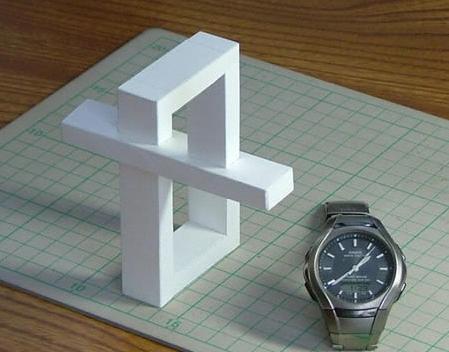
another one:
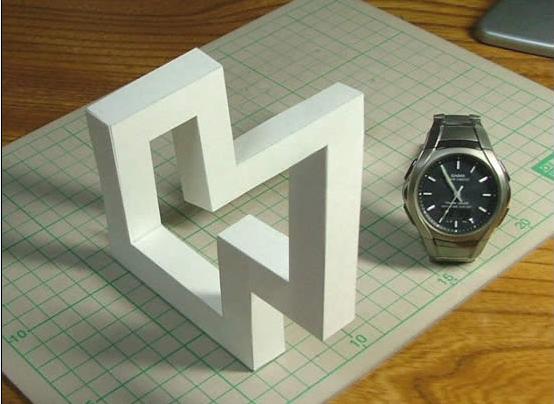

Guess the Famous Physcist in this picture
another one:
Guess the Famous Physcist in this picture
Monday, October 8, 2007



Steven's Optical Illusions
Do you see any grey dots where the black lines intersect? In fact, there is nothing.


3 Perfect Squares:


Joe's "Still" Images
No explation need.

Like the above illusion, move your eyes across the Still image. Don't look for too long, or you will become nauseous.


Like the above illusion, move your eyes across the Still image. Don't look for too long, or you will become nauseous.

Subscribe to:
Posts (Atom)